
Rural Community Immigration Pilot (RCIP) Canada
The Rural Community Immigration Pilot (RCIP) is a federal economic immigration pathway designed to help participating rural and remote Canadian communities attract and retain skilled workers.
The RCIP provides a pathway to permanent residence for qualifying candidates who have an eligible job offer from a designated employer and receive a recommendation from a participating community.
The program is currently open and includes 14 participating rural communities across Canada.
RCIP Participating Communities
The 14 participating RCIP communities are:
- Pictou County, Nova Scotia
- North Bay and Area, Ontario
- Sudbury, Ontario
- Timmins, Ontario
- Sault Ste. Marie, Ontario
- Thunder Bay, Ontario
- Steinbach, Manitoba
- Altona/Rhineland, Manitoba
- Brandon, Manitoba
- Moose Jaw, Saskatchewan
- Claresholm, Alberta
- West Kootenay, British Columbia
- North Okanagan Shuswap, British Columbia
- Peace Liard, British Columbia
Each community establishes its own priority sectors, priority occupations, designated employers and recommendation procedures.
This means that meeting IRCC’s federal eligibility requirements does not by itself guarantee that a candidate will receive a community recommendation.
RCIP Designated Employer Requirement
To apply through RCIP, an applicant must have a qualifying job offer from an employer that has been designated by the participating community.
The program does not simply allow any employer located in a rural area to issue an eligible job offer.
Participating communities are responsible for designating employers within their region.
RCIP Job Offer Requirements
The qualifying job must generally be:
- located within the participating community boundaries
- full-time, meaning at least 30 paid hours per week
- non-seasonal
- indeterminate, meaning there is no set end date
- from a designated employer
The offer must also represent genuine employment within the participating community.
Unlike many temporary foreign worker situations, an LMIA is not required for the RCIP community recommendation process.
RCIP Work Experience Requirement
Most applicants need at least one year, or 1,560 hours, of related work experience during the three years before applying.
The experience must generally:
- be paid
- not be self-employment
- correspond to the occupational description
- include most of the main duties
- fall within an eligible TEER relationship to the job offer
Work Experience and Job Offer TEER
| RCIP Job Offer | Column 2 |
|---|---|
| TEER 0 or 1 | TEER 0, 1, 2 or 3 |
| TEER 2 | TEER 1, 2, 3 or 4 |
| TEER 3 or 4 | TEER 2, 3 or 4 |
| TEER 5 | Same five-digit NOC |
There is also a specific exception for certain nursing and health-care occupations.
International Graduate Work Experience Exemption
Certain international graduates who studied in the participating community may be exempt from the work-experience requirement.
For an eligible program of two years or longer, the graduate must generally have studied full-time, received the credential no more than 18 months before applying for permanent residence, and lived in the community for at least 16 of the final 24 months of study.
A separate exemption may apply to an eligible master’s degree or higher lasting two years or less, provided the applicant studied full-time, obtained the degree within 18 months before applying and lived in the community throughout the studies.
The credential must generally come from a publicly funded Canadian post-secondary institution in the recommending community.
RCIP Language Requirements
The minimum required language level depends on the TEER category of the job offer.
| Job Offer | Minimum Language Level |
|---|---|
| TEER 0 or 1 | CLB/NCLC 6 |
| TEER 2 or 3 | CLB/NCLC 5 |
| TEER 4 or 5 | CLB/NCLC 4 |
Applicants must use an approved language test and meet the minimum level in each required language ability.
RCIP Education Requirement
Applicants generally need at least:
a recognized Canadian secondary-school or post-secondary credential,
or
a qualifying foreign educational credential supported by an Educational Credential Assessment (ECA).
An ECA used for this purpose generally must be less than five years old when the applicant applies.
Settlement Funds
Applicants normally must show that they have sufficient settlement funds for themselves and their family.
IRCC currently exempts applicants from this proof-of-funds requirement if they are already working in Canada with a valid work permit.
Because settlement-fund amounts are adjusted periodically, the amount should be checked against the current IRCC table immediately before application rather than relying on an older figure.
Community Recommendation
A job offer alone is not enough.
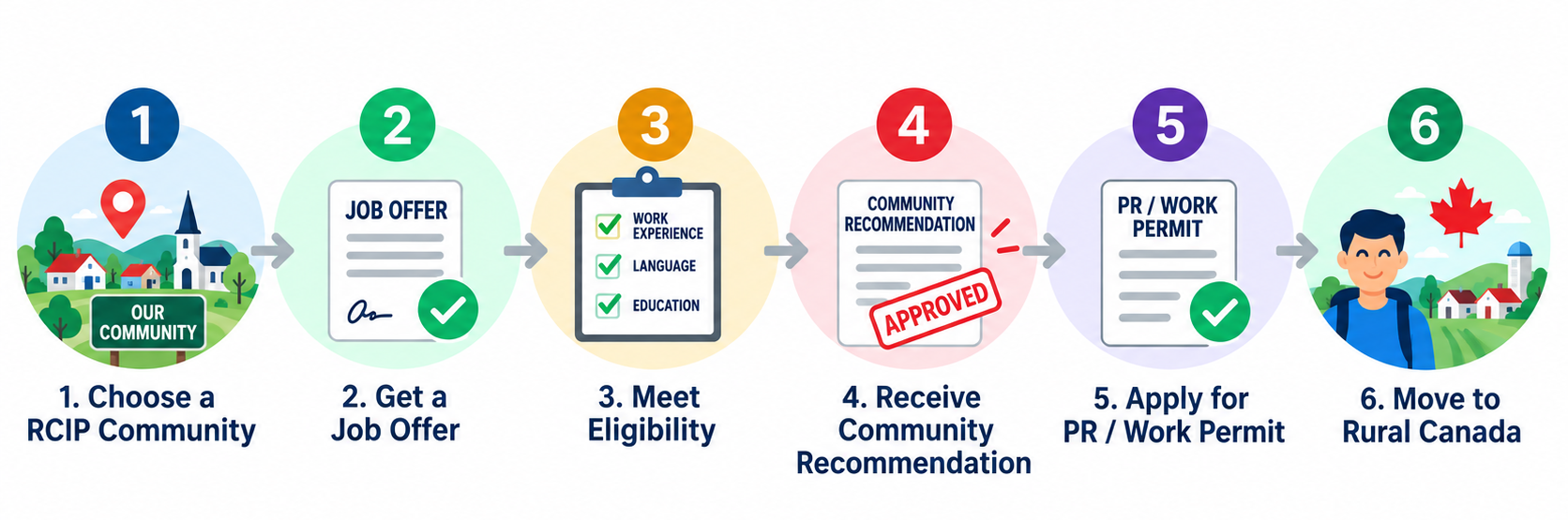
Once the applicant has an eligible offer from a designated employer, the employer submits the candidate’s recommendation application to the participating community.
The community assesses factors including whether the job falls within its priority sectors or occupations, whether the job offer is genuine and whether the candidate meets pilot requirements.
If the community approves the application, it issues a community recommendation certificate.
Only after obtaining the recommendation can the candidate proceed with the RCIP permanent residence application.
RCIP Permanent Residence Application
After receiving the community recommendation, the applicant can apply for permanent residence through IRCC’s Permanent Residence Portal.
The federal application includes evidence relating to the community recommendation, job offer, language, education, work experience, settlement funds and other applicable immigration requirements.
Optional RCIP Work Permit
An RCIP applicant who has submitted a permanent residence application may also be eligible for a two-year employer-specific work permit.
The permit is specific to the employer who made the qualifying RCIP job offer.
A spouse or common-law partner may also apply for an open work permit. Under the current RCIP rules, that spouse’s work permit permits employment only within the same participating community.
The optional RCIP work permit should not be confused with the permanent residence application itself. Approval of temporary work authorization does not guarantee PR approval.
How the RCIP Process Works
RCIP vs. the Former RNIP
The Rural Community Immigration Pilot (RCIP) is not the same program as the former Rural and Northern Immigration Pilot (RNIP).
RNIP stopped accepting new applications on August 31, 2024. RCIP is the newer rural economic immigration pilot and operates under its own participating-community, employer-designation and eligibility rules.
This distinction is important because older online articles may still describe RNIP requirements that do not apply to a new RCIP application.
FAQ
Explore Permanent Residence Through a Rural Canadian Community
RCIP eligibility depends on the interaction between your NOC, previous work experience, language results, education, designated employer, job offer and the participating community’s current priorities.
Because each RCIP community may establish its own priority sectors, occupations, employer lists and selection procedures, an applicant who qualifies federally may not necessarily qualify for every participating community.





Passionate – Dedicated – Professional
Navigating Canadian immigration with confidence
We believe that immigration is a powerful tool for building a better future, and we are dedicated to helping our clients realize their dreams of living and working in Canada.