

LMIA Work Permit Canada
Working in Canada often requires a valid work permit. For many employer-specific work permits, a Canadian employer must first obtain a positive Labour Market Impact Assessment (LMIA) before the foreign worker can apply for a work permit.
An LMIA is generally used to demonstrate that there is a need for a foreign worker to fill a position and that hiring the worker is consistent with the requirements of Canada’s Temporary Foreign Worker Program. However, not every work permit requires an LMIA. Some workers may qualify under an LMIA-exempt category or for an open work permit.
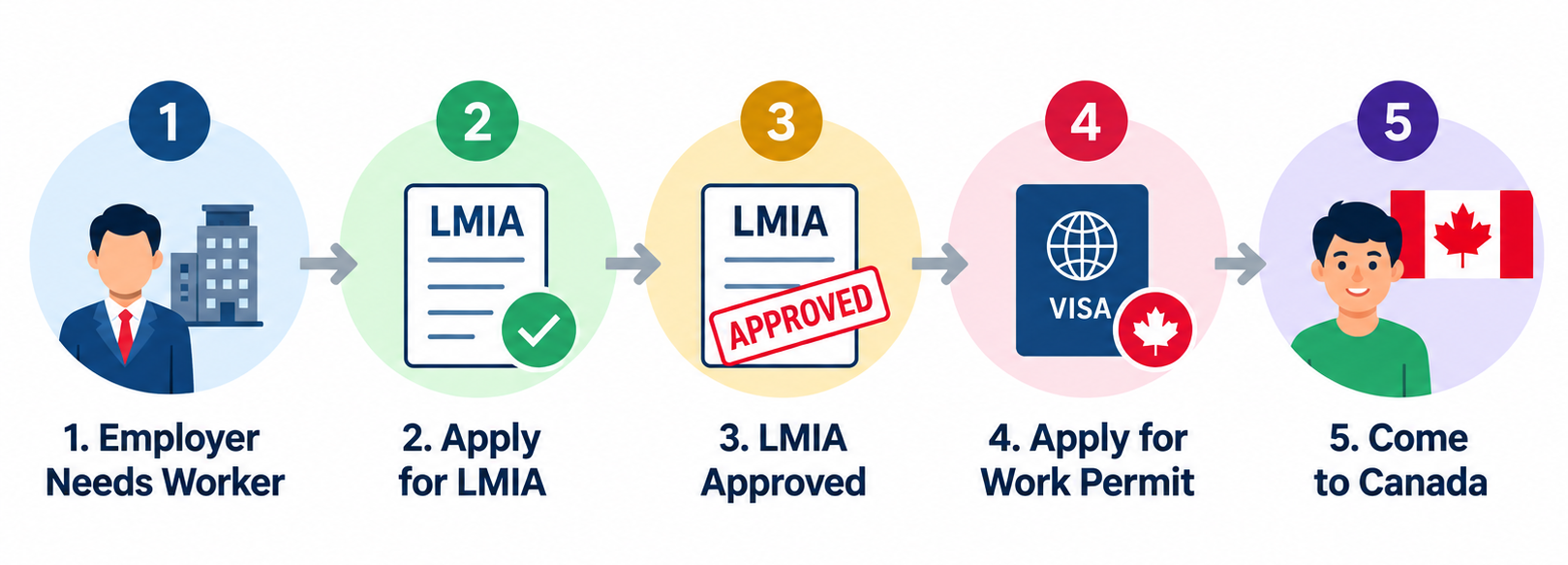
How the LMIA Work Permit Process Works
For an LMIA-based work permit, the process normally involves two separate stages.
Stage 1 – Employer LMIA Application
The Canadian employer applies to Employment and Social Development Canada (ESDC)/Service Canada for an LMIA. Depending on the position, wage and location, the employer may need to meet recruitment, wage, business legitimacy and other Temporary Foreign Worker Program requirements.
Stage 2 – Work Permit Application
After a positive LMIA is issued, the foreign worker may apply to Immigration, Refugees and Citizenship Canada (IRCC) for an employer-specific work permit.
A positive LMIA does not automatically guarantee approval of a work permit. The worker must independently meet IRCC’s work permit and admissibility requirements.
High-Wage vs. Low-Wage LMIA
LMIA applications under Canada’s Temporary Foreign Worker Program are generally classified as either High-Wage or Low-Wage based on the wage offered for the position and the applicable provincial or territorial hourly wage threshold.
The classification is important because High-Wage and Low-Wage LMIA applications are subject to different employer requirements.
High-Wage LMIA
A position is generally considered High-Wage when the wage offered is at or above the applicable provincial or territorial hourly wage threshold.
For LMIA applications received on or after July 17, 2026, the Ontario threshold is $36.92 per hour.
Employers applying under the High-Wage Stream may be required to:
- demonstrate that the offered wage meets the prevailing wage for the occupation and location;
- conduct the required recruitment and advertising for Canadians and permanent residents;
- provide a Transition Plan explaining how the employer intends to reduce reliance on temporary foreign workers over time; and
- meet all applicable Temporary Foreign Worker Program requirements.
Employers applying for a High-Wage LMIA may generally request an employment duration of up to three years, although the requested duration must reflect the employer’s reasonable employment needs.
Low-Wage LMIA
A position is generally considered Low-Wage when the offered wage is below the applicable provincial or territorial hourly wage threshold.
Low-Wage LMIA applications are subject to additional restrictions intended to limit reliance on temporary foreign workers.
Depending on the employer, occupation and work location, these requirements may include:
- a general 10% cap on the proportion of workers employed in Low-Wage positions;
- a 20% cap for certain designated sectors and occupations, including specified construction, food manufacturing, hospital, nursing/residential care and caregiver positions;
- restrictions on processing Low-Wage LMIA applications in certain Census Metropolitan Areas (CMAs) with an unemployment rate of 6% or higher, subject to specified exemptions;
- employer responsibility for certain transportation costs;
- requirements relating to suitable and affordable housing; and
- private health insurance requirements where applicable.
Employers submitting a Low-Wage LMIA may generally request a maximum employment duration of one year.
Ontario LMIA Wage Threshold
As of July 17, 2026:
Ontario High-Wage threshold: $36.92/hour
- $36.92/hour or more: generally processed under the High-Wage Stream
- Below $36.92/hour: generally processed under the Low-Wage Stream
The wage threshold alone does not determine whether an LMIA can be approved. The employer must also offer a wage that meets the applicable prevailing wage for the occupation and work location and satisfy the other requirements of the Temporary Foreign Worker Program.
Wage thresholds and Low-Wage processing restrictions can change. Employers should verify the applicable requirements before advertising the position or submitting an LMIA application.
Our LMIA and Work Permit Services
Topic Immigration assists Canadian employers and foreign workers with eligibility assessment, NOC classification, LMIA documentation, employer requirements, work permit applications, extensions and changes of employer or employment conditions.
Because LMIA and work permit requirements can change depending on the occupation, wage, location and applicant’s immigration history, each case should be assessed individually.
FAQ
Need Help With an LMIA or Canadian Work Permit?
Contact Topic Immigration for a professional assessment of your employer and work permit situation.
Official IRCC guidance confirms that employer-specific work permits generally require a job offer and that the employer may need an LMIA.
Passionate – Dedicated – Professional
Navigating Canadian immigration with confidence
We believe that immigration is a powerful tool for building a better future, and we are dedicated to helping our clients realize their dreams of living and working in Canada.