
Atlantic Immigration Program (AIP)
The Atlantic Immigration Program (AIP) is a pathway to Canadian permanent residence for eligible skilled foreign workers and international graduates who want to work and settle in one of Canada’s four Atlantic provinces:
New Brunswick, Nova Scotia, Prince Edward Island, or Newfoundland and Labrador.
A key feature of the program is that applicants need a qualifying job offer from a designated Atlantic employer. The employer and province also play a direct role in the immigration process through settlement planning and provincial endorsement.
Who Can Apply Through the Atlantic Immigration Program?
To qualify for permanent residence under the AIP, applicants generally need to meet requirements involving:
- a valid job offer from a designated employer
- qualifying work experience, unless an international-graduate exemption applies
- education
- language ability
- settlement funds, where required
- a settlement plan
- provincial endorsement
Applicants may be living either outside Canada or in Canada as temporary residents when pursuing the program.
AIP Designated Employer Requirement
Not every employer in Atlantic Canada can hire through the Atlantic Immigration Program.
The employer must first be designated by the applicable Atlantic province.
Once designated, the employer can make an eligible job offer under the program and participate in the provincial endorsement process.
The four participating provinces maintain their own designation and endorsement procedures.
AIP Job Offer Requirements
A qualifying AIP job offer must generally be:
- full-time, meaning at least 30 hours per week
- non-seasonal
- from a designated employer
- for work the applicant is qualified and able to perform
For TEER 0, 1, 2 or 3, the job offer must normally last for at least one year from the date the applicant becomes a permanent resident.
For a TEER 4 occupation, the job offer must be for permanent employment with no set end date.
The job offer must also generally be at the same or a higher occupational level than the work experience being used to qualify, subject to specific exceptions including certain health-care occupations and qualifying Atlantic international graduates.
Work Experience Requirement
Most skilled-worker applicants need at least 1,560 hours of related work experience during the five years before applying.
IRCC describes this as the equivalent of working approximately 30 hours per week for one year, and the experience must have been accumulated over at least one year.
Your previous occupation must also meet the applicable relationship between the NOC/TEER of your work experience and the NOC/TEER of your job offer.
International Graduate Exemption
Certain graduates of recognized post-secondary institutions in Atlantic Canada do not need to meet the AIP work-experience requirement.
Generally, the applicant must have completed an eligible credential that took at least two years, studied full-time, received the credential less than two years before applying for permanent residence, and lived in an Atlantic province for at least 16 months during the final two years before graduation. Additional restrictions apply to some language-study, distance-learning and scholarship programs.
Language Requirements
The minimum language level depends on the TEER category of the AIP job offer.
| Job Offer | Minimum Language Level |
|---|---|
| TEER 0, 1, 2 or 3 | CLB/NCLC 5 |
| TEER 4 | CLB/NCLC 4 |
Applicants must submit results from an approved language test, and the results must be less than two years old when the application is submitted.
Education Requirements
The education requirement also depends on the TEER level of the job offer.
For a TEER 0 or TEER 1 job offer, applicants generally need at least a Canadian one-year post-secondary credential or an equivalent foreign credential.
For TEER 2, 3 or 4, at least a Canadian secondary-school credential or equivalent is generally required.
Foreign education normally requires a valid Educational Credential Assessment (ECA).
Settlement Plan
A distinctive feature of the Atlantic Immigration Program is the settlement plan.
After receiving an eligible job offer, the applicant and accompanying family members work with an approved settlement service provider to assess their settlement needs and receive information and referrals for services in Atlantic Canada.
Provincial Endorsement
Receiving a job offer is not the final step before permanent residence.
The applicable Atlantic province must endorse the job offer.
The endorsement application includes information about the employer, the job offer, the applicant and the settlement plan. An LMIA is not required for the AIP endorsement process.
Once the province approves the endorsement, the applicant receives a Certificate of Endorsement and may proceed with the permanent residence application.
Optional AIP Work Permit
Some AIP applicants may qualify for a temporary work permit while the permanent residence application is being processed.
The current AIP work permit is:
valid for up to two years and employer-specific, meaning the applicant may work only for the employer supporting the application.
To qualify, the applicant generally needs an eligible job offer from a designated employer and a referral letter from the Atlantic province.
A spouse or common-law partner may also be eligible to apply for an open work permit.
Importantly, approval of the temporary work permit does not guarantee approval of permanent residence.
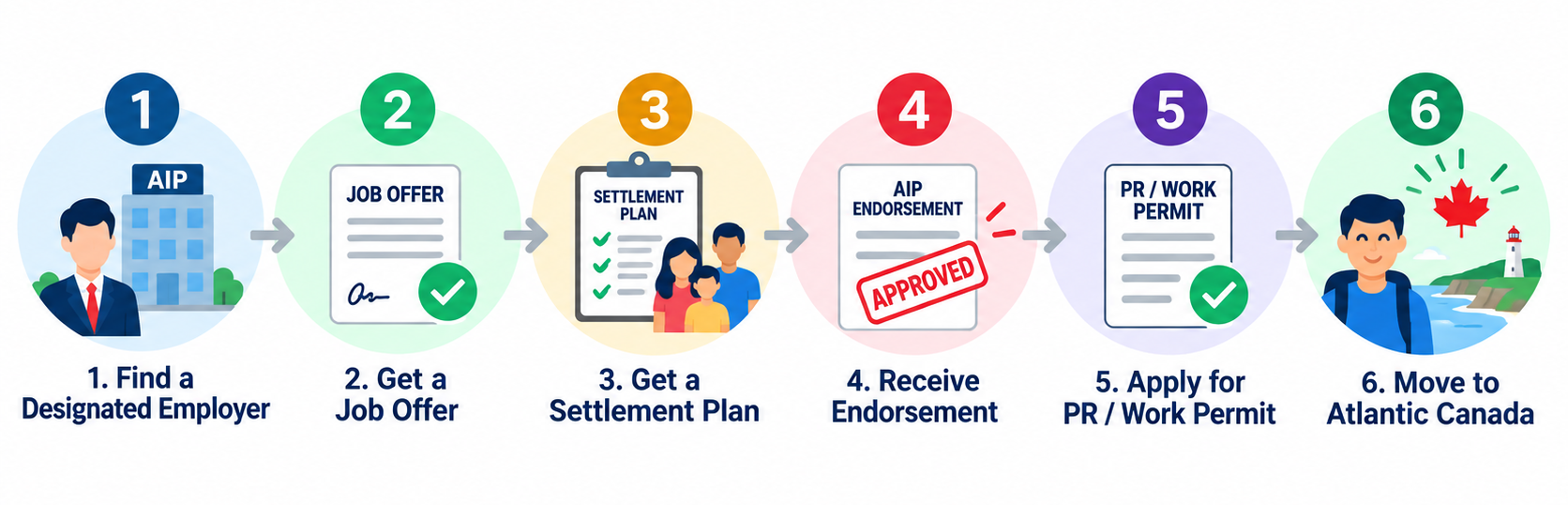
How the AIP Process Works
Common AIP Issues We Review
Topic Immigration can assist with matters such as determining whether the employer is properly designated, reviewing NOC and TEER classification, assessing previous work experience, reviewing international-graduate exemptions, checking language and education requirements, assessing job-offer eligibility, preparing the permanent residence application and reviewing eligibility for the optional AIP work permit.
FAQ
Explore Permanent Residence Through Atlantic Canada
AIP eligibility depends on more than simply having a job in Atlantic Canada. The employer designation, job offer, work experience, NOC, language, education, settlement plan and provincial endorsement all need to align with program requirements.





Passionate – Dedicated – Professional
Navigating Canadian immigration with confidence
We believe that immigration is a powerful tool for building a better future, and we are dedicated to helping our clients realize their dreams of living and working in Canada.