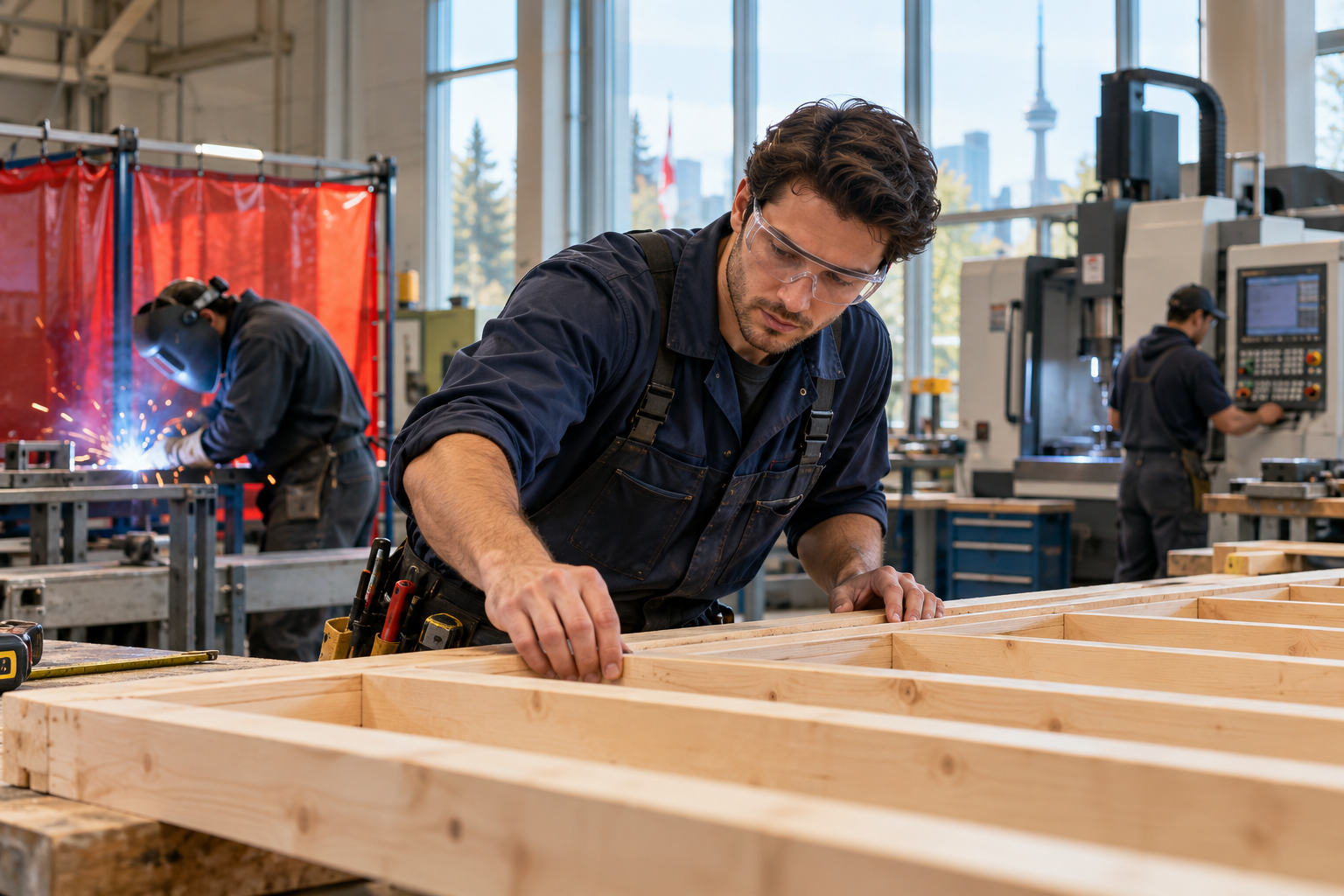
Are you considering a skilled trades career in Ontario but unsure whether you need a trade certificate to start working?
Not all skilled trades in Ontario require a Certificate of Qualification (C of Q). Several trades, including carpentry, welding, and industrial mechanical maintenance, are classified as non-compulsory trades, allowing individuals to work without mandatory trade certification.
However, employers may still require technical training, experience, safety qualifications, or specific workplace credentials.
Compulsory vs. Non-Compulsory Trades in Ontario
Ontario classifies skilled trades into two categories.
Compulsory Trades
These trades require workers performing regulated trade activities to hold the appropriate legal authorization, such as a Certificate of Qualification or registered apprenticeship status, subject to applicable exemptions.
Non-Compulsory Trades
Workers may legally perform the trade without holding a Certificate of Qualification for that trade.
Nevertheless, employers can establish their own education, training, and experience requirements.
Skilled Trades That Do Not Require Mandatory Certification
Some examples of non-compulsory trades in Ontario include:
A non-compulsory classification does not eliminate workplace safety regulations, licensing requirements under other legislation, or trade-specific employer standards.
| Trade |
Trade Code |
Career Field |
| Carpenter |
403A |
Residential and commercial construction |
| Welder |
456A |
Welding and metal fabrication |
| Industrail Mechanic Millwright |
433A |
Machinery maintenance |
| Industrail Electrician |
442A |
Industrial electrical systems |
| General Machinist |
429A |
Precision manufacturing |
| Cabine Maker |
438A |
Furniture and cabinetry |
| Brick and Stone Mason |
401A |
Masonry construction |
| Roofer |
449A |
Roofing installation/td> |
| Cook |
415A |
Culinary services |
Recommended College Programs for Skilled Trades Careers
Carpentry — George Brown Polytechnic
Program: Carpentry and Renovation Technician (T180)
This two-year Ontario College Diploma provides practical training in carpentry, renovations, construction safety, and related technical skills.
Located at the Casa Loma Campus in Toronto, the program is designed for individuals pursuing careers in residential construction and renovation.
Welding — Conestoga College
Program: Welding and Fabrication Technician
This two-year Ontario College Diploma introduces students to welding processes, fabrication techniques, and industrial manufacturing equipment.
The program also covers learning outcomes associated with Levels 1 and 2 of the Welder and Metal Fabricator apprenticeship programs.
Students may have opportunities to challenge selected Canadian Welding Bureau (CWB) qualification tests.
Industrial Mechanical Maintenance
Program Area: Mechanical Techniques – Industrial Millwright
Programs in this field introduce students to industrial mechanical systems, equipment maintenance, and mechanical repair techniques.
Graduates may explore entry-level industrial maintenance roles or pursue relevant apprenticeship opportunities.
PGWP Eligibility for International Students
International students should not assume that completing a skilled trades diploma automatically makes them eligible for a Post-Graduation Work Permit (PGWP).
Before selecting a college program, students should verify:
- Whether the institution and specific program are PGWP-eligible
- The program’s six-digit Classification of Instructional Programs (CIP) code
- Applicable field-of-study requirements
- English or French language requirements
- Program length and other PGWP eligibility conditions
IRCC has confirmed that no eligible fields of study will be added or removed during 2026. However, individual eligibility depends on the student’s circumstances and applicable rules.
Can Skilled Trades Experience Lead to Permanent Residence?
Skilled trades experience may support eligibility under certain Canadian immigration pathways, including Express Entry or Ontario immigration programs.
However, working in a non-compulsory trade does not automatically qualify an applicant for permanent residence.
Immigration eligibility depends on factors such as the applicant’s actual duties, National Occupational Classification (NOC) code, TEER category, qualifying work experience, language proficiency, and applicable program requirements.
Ontario offers several skilled trades career pathways that do not require mandatory trade certification.
Carpentry, welding, and industrial mechanical maintenance may be attractive options for individuals interested in practical technical training and long-term skilled employment.
For international students, choosing a program should involve more than career interests. PGWP eligibility and potential immigration pathways should also be assessed before enrolment.
Disclaimer
This article is intended for general informational purposes only and does not constitute legal or immigration advice. Skilled trades regulations, college programs, PGWP eligibility criteria, and immigration policies are subject to change. Always verify current requirements through the appropriate official authorities before making decisions.