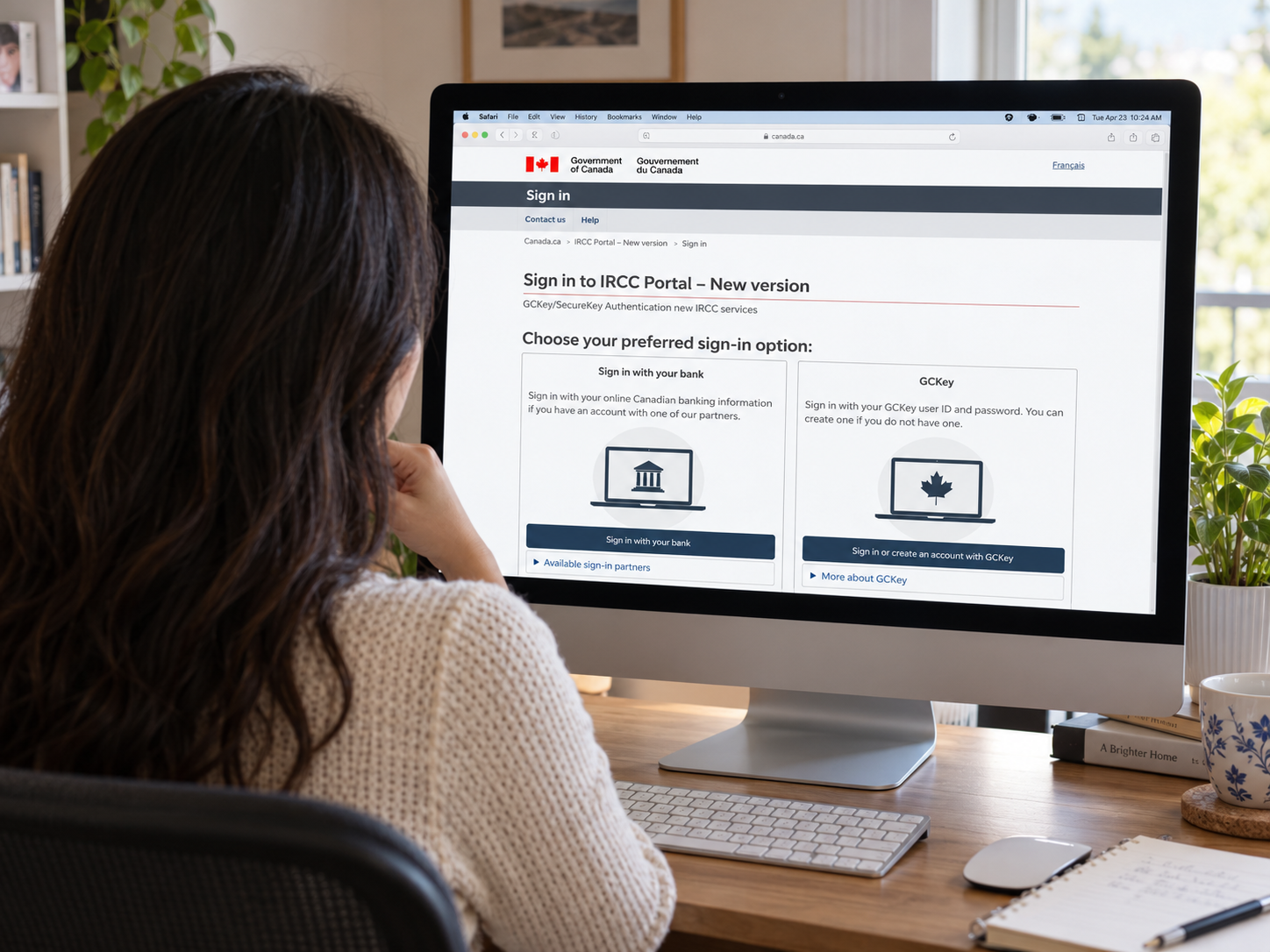


Receiving a refusal letter from Immigration, Refugees and Citizenship Canada—commonly known as IRCC—can be discouraging. However, a refusal is not always the end of the process.
The correct response depends on what was refused. A Temporary Resident Visa, study permit, work permit, permanent residence application and family sponsorship application do not all have the same remedies or deadlines.
Before submitting another application, determine exactly why the decision was made and whether the refusal affected your current status in Canada.
Read the Refusal Letter Carefully
Start by downloading and preserving:
- The complete refusal letter
- Any decision notes included with the letter
- A copy of the application and documents submitted
- Online portal messages and screenshots
- Proof of the date the decision was received
- Your current permit, visa or visitor record
The refusal letter may identify concerns such as insufficient funds, unclear purpose of travel, weak ties to the home country, employment history, missing documents, inadmissibility or misrepresentation.
Some refusal letters contain only standardized wording. In that situation, additional officer notes may be needed to understand the evidence and reasoning behind the decision.
Consider Requesting the Officer’s Notes
Applicants may seek records from IRCC through an Access to Information and Privacy request, often referred to as an ATIP or GCMS notes request.
These records may provide additional information about:
- The officer’s assessment of the application
- Documents considered during processing
- Concerns about finances, employment or travel purpose
- Credibility findings
- Eligibility or admissibility issues
- Possible factual misunderstandings
Access eligibility depends on which federal access law is being used. A representative or eligible person in Canada may be required for certain Access to Information Act requests. IRCC’s official ATIP page explains who may submit each type of request.
GCMS notes can be useful, but applicants should not wait for them if a court or appeal deadline is already running.
Reapply With a Stronger Application
Reapplication is often appropriate when the refusal can be addressed with better evidence or when the applicant’s circumstances have materially changed.
Examples include:
- More complete financial records
- A clearer source-of-funds explanation
- Updated employment evidence
- A stronger study plan
- Better documentation of family or economic ties
- Corrected forms or missing documents
- A more detailed explanation of travel purpose
- Evidence addressing the officer’s specific concerns
There is generally no mandatory waiting period after an ordinary visitor visa, study permit or work permit refusal. However, immediately resubmitting substantially the same application may lead to the same result.
A new application also requires a new processing fee and receives a new assessment. IRCC is not required to approve an application simply because additional documents have been included.
Reapplication should be approached differently if the refusal involves criminality, medical inadmissibility, misrepresentation or an active period of ineligibility.
Request Reconsideration in Limited Circumstances
A reconsideration request asks IRCC to reopen and reassess a decision. It is not a formal appeal, and an officer is generally not required to reopen the file.
Reconsideration may be appropriate when there is a clear concern that:
- The officer overlooked material evidence already submitted
- The decision relied on an obvious factual mistake
- Procedural fairness was not provided
- IRCC made an administrative error
- The reasons appear inconsistent with the application record
A reconsideration request should identify the alleged error precisely and refer to evidence that was already before the decision-maker. It should not merely express disagreement with the result.
New evidence that did not exist when the decision was made may be more suitable for a new application.
Importantly, applicants should not assume that a reconsideration request pauses or extends a Federal Court filing deadline.
Check Your Immigration Status Immediately
A refusal can have urgent consequences for someone already in Canada.
If a person applied to extend a work permit before it expired, they may have maintained status while IRCC processes the application. If the extension is refused, that maintained status and the related work authorization generally end when the refusal decision is made.
The person should stop working unless another legal authorization applies. IRCC explains maintained status and employment conditions on its expired or expiring work permit page.
Temporary residents who have lost status may be able to apply for restoration, generally within 90 days of losing their status, if they meet the applicable requirements. Restoration is not guaranteed, and an applicant normally cannot work or study while waiting unless a specific legal exception applies.
A refused application filed outside Canada usually does not cancel a separate Canadian status document that remains valid. Each document and expiry date should nevertheless be checked individually.
Determine Whether an Immigration Appeal Is Available
There is no general Immigration Appeal Division appeal for a refused visitor visa, study permit or work permit.
Certain family sponsorship refusals can be appealed to the Immigration Appeal Division. The sponsor—not the sponsored family member—normally files the appeal.
The notice of appeal must generally be received within 30 days after the sponsor receives the refusal decision. The Immigration and Refugee Board confirms both the deadline and the fact that temporary visa, study permit and work permit refusals cannot be appealed through this process on its sponsorship appeal page.
Appeal rights may be restricted in certain inadmissibility cases. The exact statutory provision and refusal reason should therefore be reviewed before assuming that an appeal is available.
Consider Federal Court Judicial Review
Judicial review is different from reapplication or an immigration appeal. The Federal Court examines whether the decision was lawful, reasonable and procedurally fair.
Under section 72 of the Immigration and Refugee Protection Act, the application begins with a request for leave. The normal filing deadline is:
- 15 days for a matter arising in Canada
- 60 days for a matter arising outside Canada
The deadline generally runs from the date the applicant was notified of or became aware of the decision. The Court may permit a late filing in limited circumstances, but an extension should never be assumed. See IRPA section 72.
Judicial review is not a new visa assessment. If the applicant succeeds, the usual result is that the refusal is set aside and the application is returned for redetermination by a different decision-maker. The Court does not ordinarily issue the visa or permit itself.
Federal Court litigation must be handled by a lawyer authorized to practise before the Court.
Treat Misrepresentation Findings Seriously
A refusal involving misrepresentation requires particular care. Providing false information, withholding material facts or submitting altered documents may lead to refusal and a ban from Canada for at least five years.
The applicant may remain responsible even if a family member, recruiter or representative prepared the documents. IRCC lists the potential consequences on its immigration fraud page.
Do not simply submit another application with a different answer. The previous application, alleged misrepresentation, procedural fairness history and period of inadmissibility should be reviewed first.
Which Option May Be Appropriate?
| Situation | Pssible response | Main caution |
|---|---|---|
| Missing or weak evidence | Stronger reapplication | Address every refusal concern |
| Clear officer or administrative error | Reconsideration request | Discretionary and does not stop court deadlines |
| Temporary status lost in Canada | Restoration application | Usually subject to a 90-day deadline; no automatic work or study |
| Eligible family sponsorship refusal | IAD appeal | Normally 30 days from receipt |
| Unreasonable or procedurally unfair decision | Federal Court judicial review | Usually 15 or 60 days |
| Misrepresentation finding | Immediate legal assessment | A five-year or longer consequence may apply |
FAQ
Q1. Can I reapply immediately after a Canadian visa refusal?
Usually, yes, if no ban or period of ineligibility applies. However, reapplying with substantially the same information may produce the same result. The new application should directly address the previous concerns.
Q2. Does ordering GCMS notes extend my appeal or court deadline?
No. Requesting records does not automatically suspend an Immigration Appeal Division or Federal Court deadline. Preserve the applicable deadline while seeking the notes.
Q3. Will a previous refusal negatively affect every future application?
Not necessarily. A previous refusal must be disclosed, but it does not automatically prevent future approval. The applicant should explain what changed and how the earlier concerns have been resolved.
Disclaimer
This article provides general information and is not legal advice. Available remedies, deadlines and immigration-status consequences depend on the application type, place of decision, refusal reasons and individual circumstances.
Written by Brian B. Lee, RCIC, MA, B. Eng
RCIC #R518340
About the Author: Brian B. Lee

Related Posts


Brian B. Lee, RCIC, MA, B Eng.

Brian B. Lee is a licensed Regulated Canadian Immigration Consultant (RCIC) and a member in good standing of the College of Immigration and Citizenship Consultants (CICC) (License No. R518340).
MON - FRI
10 AM ~ 6 PM
2 Sheppard Ave. East, Suite 1520, Toronto, ON, M2N 5Y7